How to Heal From Betrayal: What to Do Tonight and in the Weeks After
You heal from betrayal by treating it as a real injury: you get steady first, make sense of what happened second, and decide what comes next third. Nobody does this on a schedule, and you can start with one small thing tonight.
If you are reading this late at night, you may not be thinking straight, and that is normal. Being betrayed by a spouse or a partner, married or not, shakes the ground you were standing on. This page will not ask you to feel better fast. It will show you what helps and what to put off until morning.
We are a small editorial team of non-clinicians, and nothing here replaces a licensed therapist. What follows comes from published research and from years of conversations with people in your position.
Key takeaways
- Betrayal can cause PTSD, depression and anxiety symptoms at clinical levels in roughly 30% to 60% of betrayed people[1].
- Researchers describe recovery in broad stages, often labeled impact, meaning and moving on, and a good outcome does not require staying together[2].
- Even suspecting infidelity without proof can have strong psychological, physical and behavioral effects, so your reaction is not an overreaction[3].
- Couples who stay together after an affair can do reasonably well in therapy, roughly similar to couples in therapy for other problems[4].
- Most of the betrayed women in one study reported posttraumatic growth, but growth comes after the pain, not instead of it[5].
- If sex happened outside the relationship, book an STI test within the first 72 hours, or as soon as possible, whatever you decide about the relationship.
In this article
- How do you heal from betrayal?
- Why does being betrayed hurt this much?
- What should you do first after being betrayed?
- What does healing look like week by week?
- How do you stop obsessing about what happened?
- Do you have to decide whether to stay before you can heal?
- Can therapy help you heal from betrayal?
- Can you heal if you stay together?
- Can you heal after a breakup caused by cheating?
- When is it more than ordinary pain?
How do you heal from betrayal?
Healing means working through three overlapping tasks: absorbing the shock, understanding what happened, and moving forward on your own terms. These are not tidy steps, and you will circle back to earlier ones.
One clinical model, written for therapists, names the stages "impact," "meaning," and "moving on." It aims to help people get past the initial shock, understand what happened, think clearly about their best interests before acting, and move on emotionally whether or not they reconcile[2]. Pay attention to the last clause. Healing and staying are two separate questions.
A grounded theory study of couples who healed lists what many did: assessed the damage, affirmed commitment, set up accountability, talked deeply, rebuilt trust, and moved from initial to deeper forgiveness[6]. That describes couples who stayed. If you are on your own, the same early work still applies: face the damage and let yourself grieve before you decide anything big.
For a longer walk through the whole process, see our guide on how to heal after infidelity.
Why does being betrayed hurt this much?
It hurts this much because betrayal attacks both your trust in a person and your picture of your own life. Your body reacts as if you are in danger, because on some level you are.
Researchers describe infidelity as an attachment injury that shatters basic assumptions about the relationship[7]. The person you turn to for safety became the source of the harm. That is why sleep goes, appetite goes, and your mind replays things on a loop.
Studies back up how heavy this can be. One study of unmarried young adults found that 45.2% reported symptoms suggesting likely infidelity-related PTSD, and those symptoms were clearly associated with depressive symptoms[8]. In a small qualitative study, every woman interviewed developed PTSD symptoms after discovering her husband's infidelity, and suspecting beforehand did not soften the blow[9].
Learning the language for this can help. In interviews with 13 betrayed people, those who read trauma and PTSD explanations of betrayal reported clarity, validation and relief[1]. If you want to check how closely your symptoms fit, our free betrayal trauma quiz gives you a starting point and cannot diagnose you.
What should you do first after being betrayed?
Do the smallest protective things first, and delay the big decisions. In the first three days, you are trying to stay safe, fed and rested, and to book an STI test if it applies, not to solve your marriage or relationship.
Here is a short list for the first 24 to 72 hours:
- Eat something and drink water, even if it is toast.
- Tell one trusted person. Not everyone, one.
- Do not make permanent decisions: skip ultimatums, moving out in a rage, and posting anything.
- Write down questions you want answered, so you are not trying to hold them in your head at 3 a.m.
- Put off big conversations with your partner until you have slept.
If sex happened outside the relationship, get tested for STIs, even if your partner says it was safe. Book a test within the first 72 hours, or as soon as possible. CDC lists a partner who has an STI, new partners and multiple partners as risk factors for testing, and it notes that confidential, free or low-cost clinics exist if you do not want to ask your regular provider[10]. Testing protects you. It does not mean you have decided anything about the relationship.
Our free kit, The First 30 Days After You Found Out, lays out the early weeks day by day.
If your partner is controlling, threatening or violent, contact the National Domestic Violence Hotline at 1-800-799-7233 or thehotline.org. Your safety comes before every other question on this page.
What does healing look like week by week?
Healing looks uneven, with good hours followed by bad ones, and it usually moves from raw survival to understanding to a steadier life. The table below describes the broad pattern, not a calendar.
The three labels come from the clinical model described earlier[2]. The middle column describes what many people we talk with say they feel in each phase.
| Phase | What it often feels like | One small step |
|---|---|---|
| Impact | Shock, numbness, rage, crying, no appetite, replaying the discovery | Sleep, eat, get tested if needed, tell one safe person |
| Meaning | Needing to understand why, going back over the past, wanting answers | Write your questions, read about why people cheat, consider a therapist |
| Moving on | More good days, less checking, clearer choices about the relationship | Decide what you need, set boundaries, rebuild routines |
Many people we talk with say the second month is harder than the first, because the shock wears off and the full loss sinks in. If that is where you are, it does not mean you are going backward. Our pages on the stages of grief after infidelity and how long it takes to get over infidelity explain more.
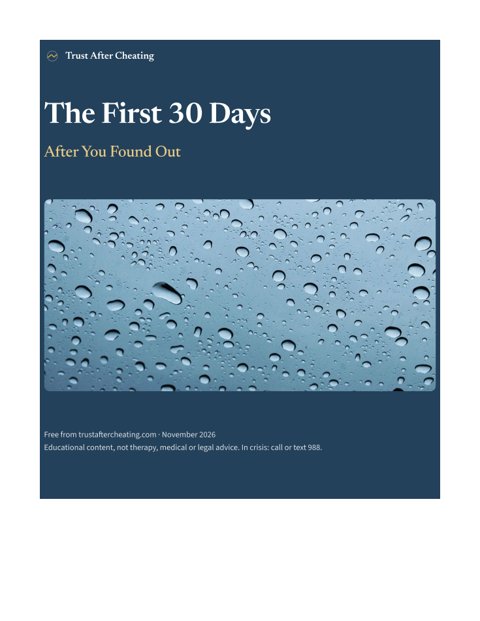
Free kit: The First 30 Days After You Found Out
What to do (and not do) in the first month, day by day, with the questions to ask and a simple tracker. Printable.
Sent. Check your inbox in a minute. Or download it now.
Free. Private. A few helpful emails after that, unsubscribe in one click.
How do you stop obsessing about what happened?
You will not stop it on command, but you can shrink it by giving the thoughts a place and a time. Obsessing and flashbacks are common enough that at least one well-known book on affair recovery devotes a chapter to coping with them[11].
Some research suggests the mind does this for a reason. In a study of people who went through a breakup caused by infidelity, disrupted core beliefs led first to intrusive rumination and then to deliberate rumination, which later helped people refine what they wanted in a partner and detach from the old relationship[12]. The thinking is painful, but it is part of how the mind rebuilds.
What helps in practice:
- Set a worry window. Give yourself 15 minutes a day to think about it on paper, then stop.
- Move your body. A walk breaks the loop better than arguing with your thoughts.
- Name the flashback. Say to yourself, "This is a memory, and I am safe right now."
- Ask, do not spy. Reading a partner's phone in secret, tracking them or hiring someone to follow them can be illegal and usually backfires. If you need answers, ask directly, or work through a therapist.
What we see: Many people say the urge to check, search and piece together every detail peaks in the first weeks, then eases once they get honest answers to a few key questions. Those who keep digging without answers often stay stuck longer.
Do you have to decide whether to stay before you can heal?
No. You can start healing before you know whether you are staying, and in most cases you should. The first-stage work is the same either way.
The clinical model mentioned earlier explicitly aims at helping people move on emotionally "whether or not they reconcile"[2]. Pressing yourself to decide in week one usually produces a decision made out of panic, in either direction.
A better approach for now:
- Give yourself a decision date weeks away, not days.
- Notice what your partner does, not only what they say: honesty, accountability, patience with your questions.
- Keep your own support in place no matter what.
When you are ready, our free quiz on whether to stay or leave can help you sort your thinking. If money, custody or divorce come up, talk to a family lawyer in your state before you act.
Can therapy help you heal from betrayal?
Yes, therapy can help, and the research on couples therapy after an affair is encouraging if mixed. A licensed therapist can help you with the trauma symptoms whether or not your partner joins.
In a randomized trial of 89 couples who had disclosed an affair within the past 6 months, anxiety improved with large effect sizes for both partners compared with a waitlist. But the treatment improved individual complaints, and not relationship satisfaction enough for both partners[13]. Therapy may help you feel better before it helps the relationship.
The Gottmans' Trust Revival Method has three stages, Atonement, Attunement and Attachment, and its effectiveness is being studied in a randomized clinical trial[14]. A study applying it to couples after an affair uses a randomized waitlist-control design[15]. We cannot tell you yet how well it works, so treat any promise of a guaranteed method with caution.
The Gottman page also says that if both partners are committed to reconciling, or at least to trying, seeing a couples therapist together is most helpful[14]. If you are on your own, an individual therapist who works with trauma or betrayal is a sound choice.
Can you heal if you stay together?
Yes, many people do, though it takes work from both partners over a long stretch. Staying is not a sign you are weak, and leaving is not a sign you are strong. Both can be right depending on what the person who cheated does next.
In a community sample of 145 couples dealing with infidelity, outcomes in couple therapy were reasonably good and roughly similar to those of couples in therapy for non-infidelity problems[4]. An earlier exploratory study found that infidelity couples started therapy more distressed but improved at a greater rate, though the group was small[16]. In a follow-up with only 19 infidelity couples, those who stayed married did not differ from other couples in stability or satisfaction[17].
Repair seems to depend on what happens inside the relationship. The grounded theory study stresses therapy, open communication, processing emotions, and a reciprocal process of restoring trust[6]. Reciprocal means both people carry weight: one is accountable and the other is willing to look at the repair honestly.
To see where you are in that process, try our free trust rebuild quiz.
Can you heal after a breakup caused by cheating?
Yes. People who leave heal too, and there is a recognizable path to it. Research on this group is thinner than research on couples who stay, but what exists is hopeful.
In one study, people whose breakup was caused by infidelity went from disrupted core beliefs to intrusive and then deliberate rumination. That helped them refine what they want in a partner, detach from the former relationship, and open up to new connections[12]. The pain does useful work.
Some practical points if you are leaving:
- Expect grief for the person you thought they were, not only the person they turned out to be.
- Expect the pull to go back, especially at night.
- Protect your daily routine: sleep, meals, movement, people.
Our guide to getting over a cheating spouse goes further.
When is it more than ordinary pain?
Pain goes beyond the ordinary when symptoms stay severe, take over your day, or make you feel unsafe. Bring in a professional at that point and stop waiting it out.
Between 30% and 60% of betrayed people have PTSD, depression and anxiety symptoms at clinical levels[1]. You are not alone, and you are not broken. But untreated, these symptoms can wear down your work, your health and your sense of self.
Signs to get help soon:
- You cannot sleep for several nights in a row.
- You avoid anything that reminds you of the betrayal, or you startle easily.
- You feel numb or detached for days.
- You are drinking or using more than usual to cope.
Late one night, if you start to feel hopeless or unsafe with yourself, call or text 988, the Suicide and Crisis Lifeline. It is free and open all hours.
Many people reach out early. In one study of betrayed women, 55% sought help within the first month after discovery, 15% within six months and 29% after six months. Most of the women also reported posttraumatic growth[5]. The study does not tell us how late help turned out, but starting at any point is better than waiting out severe symptoms.
If you are not safe or not okay right now: call or text 988 (Suicide & Crisis Lifeline, 24/7). If your partner threatens, controls or hurts you, call the National Domestic Violence Hotline at 1-800-799-7233 or chat at thehotline.org.
Frequently asked questions
Is it normal to feel physically sick after being betrayed?
Yes. Suspecting a partner's infidelity, even without proof, can have strong psychological, physical and behavioral effects[3]. Nausea, shaking, chest tightness and not eating are common. If it lasts or worries you, see a doctor.
Does knowing it was coming make it hurt less?
Often not. In a small qualitative study of women, suspecting infidelity did not lessen the impact of discovery[9]. Many people also say that being right brought its own grief, on top of the pain.
Should I tell my friends and family?
Tell one person you trust to keep it private and not push you toward a decision. Telling everyone in the first week can lock you into a story before you know what you want. You can widen the circle later.
Does it count as betrayal if we were not married?
Yes. Research on infidelity-related PTSD symptoms in unmarried young adults found a clear association with depressive symptoms[8]. Your pain does not need a ring to be real.
Can I trust again after being betrayed?
Many people do, but not quickly or automatically. Trust returns when someone shows accountability over time and when you rebuild your trust in your own judgment. The research describes re-establishing trust as a reciprocal process between both partners[6].
Do I have to forgive to heal?
No. Some couples work toward forgiveness over time, and one study of couples who healed describes a move from initial to deeper forgiveness[6]. But you can heal, set boundaries and build a good life without forgiving the person who hurt you.
Where should I start if I can only do one thing today?
Choose one: get tested if you need to, tell one safe person, or sleep. Then open our Healing and moving on section when you are ready for the next step. You do not need to fix everything tonight.
What to do next
These steps cover the next two weeks. Start with the first one tonight.
- Tell one safe person tonight. Choose someone who will listen without telling you what to do. Ten minutes is enough.
- Book your STI test within 72 hours, and keep the therapist call within 7 days. If sex happened outside the relationship, book a test within the first 72 hours, or as soon as possible. Also call one trauma-informed individual therapist within 7 days to ask about a first session.
- Start a 15-minute worry window. Once a day for 14 days, write your thoughts and questions on paper, then close the notebook.
- Set a decision date. Pick a day at least 3 weeks away to think about whether you are staying, and hold off on big decisions until then.
- Track sleep and meals for 7 days. A one-line note each morning shows you whether things are easing or taking over.
See a licensed therapist or your doctor if you cannot sleep for several nights in a row or feel numb for days, call the National Domestic Violence Hotline at 1-800-799-7233 if your partner is controlling or threatening, and call or text 988 if you feel unsafe with yourself.
If you want a clearer sense of what you are carrying right now, our betrayal trauma quiz takes a few minutes.
Sources
- Lonergan, M., et al. (2021). Is romantic partner betrayal a form of traumatic experience? A qualitative study. Stress and Health (Wiley). onlinelibrary.wiley.com/doi/abs/10.1002/smi.2968
- Baucom, D. H., Snyder, D. K., & Gordon, K. C. (2009). Helping Couples Get Past the Affair: A Clinician's Guide. Guilford Press (listing seen on routledge.com). routledge.com/Helping-Couples-Get-Past-the-Affair-A-Clinicians-Guide/B
- Weigel et al. (Weigel & Shrout) (2021). Suspicious minds: The psychological, physical and behavioral consequences of suspecting a partner's infidelity. Journal of Social and Personal Relationships (SAGE). journals.sagepub.com/doi/10.1177/0265407520975851
- Atkins, D. C., et al. (2010). Outcomes of Couples With Infidelity in a Community-Based Sample of Couple Therapy. Journal of Family Psychology (APA). researchgate.net/profile/David-Atkins-3/publication/44569186_Outcomes_
- Laaser, D., Putney, H. L., Bundick, M., Delmonico, D. L., & Griffin, E. J. (2017). Posttraumatic Growth in Relationally Betrayed Women. Journal of Marital and Family Therapy. cdn.ymaws.com/iitap.com/resource/resmgr/arie_files/m2-ptsd_growth_wome
- Fife, S. T., Gossner, J. D., et al. (2023). Couple healing from infidelity: A grounded theory study. Journal of Social and Personal Relationships (SAGE). journals.sagepub.com/doi/abs/10.1177/02654075231177874
- Not listed in the result I saw (2020). Examining the Role of the Attachment Bond in the Process of Recovering from an Affair. The American Journal of Family Therapy. doi.org/10.1080/01926187.2020.1791763
- Roos et al. (2019). Post-traumatic stress and psychological health following infidelity in unmarried young adults. Stress and Health. researchgate.net/publication/333787481_Post-traumatic_stress_and_psych
- Butler, S. (2025). A Phenomenological Study of Women's Discovery of Infidelity in Long-term Relationships. Liberty University (Digital Commons doctoral dissertation). digitalcommons.liberty.edu/doctoral/6561
- CDC (2025). Which STD tests should I get?. Centers for Disease Control and Prevention. cdc.gov/sti/about/which-std-tests-should-i-get.html
- Glass, S. (with Staeheli, J. C.) (2007). NOT "Just Friends": Rebuilding Trust and Recovering Your Sanity After Infidelity. Free Press / Simon & Schuster. books.google.com/books/about/NOT_Just_Friends.html?id=MRMl9FqDmEwC
- O'Connor, V., Canevello, A., et al. (2019). Recovery and Moving On After Breakups Caused by Infidelity. Journal of Loss and Trauma (Taylor & Francis). tandfonline.com/doi/abs/10.1080/15325024.2019.1603005
- Kröger et al. (2012). Therapy for couples after an affair: A randomized-controlled trial. Behaviour Research and Therapy (ScienceDirect). sciencedirect.com/science/article/abs/pii/S0005796712001428
- The Gottman Institute (John and Julie Gottman) (None). Practical, Science-Based Steps to Heal from an Affair. The Gottman Institute. gottman.com/blog/practical-science-based-steps-to-heal-from-an-affair/
- Not listed in the result I saw (None). Validating the Effectiveness of a Gottman Method Couples Therapy Intervention, the Trust Revival Method, for Affair Recovery: A Randomized Control Trial. ResearchGate-hosted study record (publisher not shown). researchgate.net/publication/363064820_Validating_the_Effectiveness_of
- Atkins, D. C., Eldridge, K. A., Baucom, D. H., & Christensen, A. (2005). Infidelity and Behavioral Couple Therapy: Optimism in the Face of Betrayal. Journal of Consulting and Clinical Psychology (APA); the page shown is a ResearchGate copy. researchgate.net/publication/8022987_Infidelity_and_Behavioral_Couple_
- Marin, R. A., Christensen, A., & Atkins, D. C. (2014). Infidelity and Behavioral Couple Therapy: Relationship Outcomes Over 5 Years Following Therapy. Couple and Family Psychology: Research and Practice (APA); the page shown is a ResearchGate copy. researchgate.net/publication/263917239_Infidelity_and_behavioral_coupl
We cite studies and organizations only, never sellers. How we choose sources.